
Why Some Clients Choose Private Pay Therapy
Most people do not avoid therapy because they do not care about their mental health.
They avoid therapy because the entire process can feel overwhelming before they even start.
You finally admit something feels off.
Maybe life has felt heavy for a while.
Maybe you are exhausted from carrying stress, anxiety, relationship tension, parenting burnout, or emotional overwhelm on your own. Maybe you have spent months telling yourself things will get better once life slows down.
Then you try to find help.
Suddenly you are:
Comparing dozens of therapist profiles (did you know the average person compares 21 different therapist profiles before reaching out? Talk about decision fatigue)
Wondering who takes your insurance
Unsure what therapy even costs
Waiting weeks for callbacks
Trying to understand deductibles and copays
Feeling pressure to pick “the right” therapist
Reading words like CBT, EMDR, trauma-informed, and wondering what any of it actually means for your life
And ironically?
Finding support starts to feel stressful too.
At Kane Counseling Services, we see this all the time.
Many people are not just looking for therapy. They are looking for a clearer, more connected, less overwhelming way to get support.
That is why understanding the difference between insurance and private pay therapy matters more than most people realize.
The Real Cost of Waiting Too Long to Seek Support
Many people wait months or even years before reaching out for therapy.
According to the National Alliance on Mental Illness, the average delay between the onset of mental health symptoms and receiving treatment can be more than 10 years for some conditions.
Why do people wait?
Usually because:
They think they should be able to handle it alone
Life feels too busy
Therapy feels expensive
They feel guilty prioritizing themselves
The process feels confusing
They are emotionally exhausted already
They worry therapy will not actually help
So they try alternatives instead:
Staying busy
Numbing out
Avoiding hard conversations
Hoping things improve with time
Scrolling mental health content online
Venting without real resolution
Emotionally surviving instead of actually improving
But unresolved stress, anxiety, trauma, relationship conflict, and burnout rarely disappear just because people become better at tolerating them.
Often, the cost of waiting shows up in:
Increased anxiety and depression
Relationship strain
Emotional disconnection
Parenting overwhelm
Sleep issues
Burnout
Chronic stress symptoms
Reduced work performance
Feeling emotionally stuck
Therapy is not just about “fixing problems.” It is often about helping people stop living in constant survival mode.

What Therapy Actually Costs
One of the biggest misconceptions about therapy is that it is financially impossible.
The reality is more nuanced.
According to GoodRx and national mental health cost surveys, therapy sessions in the United States often range between approximately $100–$250 per session depending on:
Location
Provider credentials
Specialty training
Session type
Insurance coverage
Length of session
Some clients use insurance.
Some choose private pay.
Some use HSA/FSA funds.
Some qualify for financial assistance opportunities.
At Kane Counseling Services, we help clients explore the option that best fits their goals, budget, privacy preferences, and treatment needs.
How Many Therapy Sessions Does the Average Person Attend?
This surprises many people:Most people do not stay in therapy forever.
Research suggests many clients begin noticing meaningful improvement within 6–15 sessions depending on their goals, symptoms, consistency, and therapeutic relationship.
Some clients come for:
Short-term support during a difficult season
Relationship guidance
Parenting support
Anxiety management
Trauma recovery
Emotional processing
Long-term personal growth
Therapy is not one-size-fits-all.
Good therapy should feel collaborative, intentional, and connected to your actual life.
Why Some People Choose Private Pay Therapy
Private pay therapy sometimes gets misunderstood as “luxury therapy.”
But many people intentionally choose private pay because they want:
More flexibility
Greater privacy
More personalized treatment options
Fewer restrictions on care
Greater control over their therapy experience
Private pay may be a good fit if you:
Prefer not to receive a mental health diagnosis tied to insurance billing
Want more flexibility in session frequency or treatment style
Are seeking couples or family therapy that insurance may not fully cover
Have high deductibles that make insurance less helpful financially
Want more control over your medical records and privacy
Want continuity of care without insurance limitations
Some clients are surprised to discover their insurance deductible means they are paying nearly the same amount out-of-pocket anyway.
Others appreciate knowing exactly what therapy costs upfront without worrying about:
Session caps
Claim denials
Medical necessity reviews
Changing insurance networks
Preauthorization requirements
Private pay also allows therapists greater flexibility in tailoring care based on your needs instead of insurance requirements.
A Diagnosis Is More Than A Billing Code
One of the most misunderstood parts of using insurance for therapy is that insurance companies typically require a mental health diagnosis in order to pay for services.
For some people, that diagnosis is clear, accurate, and incredibly helpful. A diagnosis can provide validation, understanding, access to treatment, school accommodations, medication support, and meaningful direction for care.
But mental health is also deeply nuanced.
Not every person struggling with stress, emotional overwhelm, relationship difficulties, attention challenges, burnout, grief, parenting stress, or life transitions cleanly fits into a diagnostic category.
Human beings are more complex than checkboxes.
And yet insurance companies often require therapists to place someone into a diagnosable category before treatment is covered.
That reality can create difficult tension within the mental health system.
Let's look at an example
Imagine going to a doctor because your blood sugar occasionally spikes under stress. You are not fully diabetic, but your symptoms are concerning enough that your doctor wants you to receive additional support, monitoring, and treatment.
Now imagine the only way insurance would help pay for care was if you were formally diagnosed as diabetic.
Suddenly the conversation changes.
The diagnosis is no longer only about clinical clarity.
It also becomes tied to access, reimbursement, and affordability.
Mental health professionals face similar challenges every day.
Sometimes symptoms exist on a spectrum.
Sometimes a child is struggling, but not clearly meeting full criteria for a diagnosis. Sometimes a therapist may feel tension between:
“This person genuinely needs support”
and
“Insurance requires a diagnosable condition.”
That does not mean therapists are careless or unethical.
It means the insurance system itself is diagnosis-driven.
What can this mean for parents?
As a parent, this can feel especially emotional.
If your child receives a diagnosis, you may wonder:
What does this mean long term?
Will this follow them?
Is this diagnosis fully accurate?
Is this temporary or developmental?
Could stress, sleep, trauma, learning differences, nutrition, family stress, anxiety, or maturity also be contributing?
These are thoughtful and important questions.
A diagnosis can absolutely help children receive meaningful support and accommodations when appropriate. But parents also deserve careful, individualized evaluations that look at the whole child, not just whether symptoms fit neatly into an insurance category.
Research continues to explore concerns around both underdiagnosis and overdiagnosis in areas such as ADHD and childhood mental health. Some studies suggest certain children may receive diagnoses or medication despite not fully meeting diagnostic criteria, while many others still go undiagnosed and unsupported.
The answer is not avoiding mental healthcare.The answer is thoughtful, ethical, individualized care.

WHY SOME CLIENTS CHOOSE PRIVATE PAY
This is one reason some individuals and families intentionally choose private pay therapy.
For some clients, private pay feels less medicalized and more collaborative.
Others prefer using insurance because it improves affordability and access.
Neither option is inherently right or wrong.
What matters most is understanding:
how the system works
what your options are
and what feels best for your life, goals, finances, and comfort level.
Mental health diagnoses can be life-changing in positive ways when used thoughtfully and appropriately. Many people finally feel understood after years of confusion, shame, or struggle.
At the same time, diagnoses deserve care, nuance, and context, especially when insurance reimbursement is involved.
At Kane Counseling Services, we believe clients deserve transparency, informed consent, and support that considers the whole person, not just a billing requirement.
Why Some People Prefer Using Insurance
Insurance can absolutely make therapy more financially accessible for many individuals and families.
Using insurance may be a good option if:
You already meet your deductible
Your copay is affordable
You anticipate longer-term therapy needs
You want to reduce out-of-pocket costs
Your plan has strong behavioral health coverage
For many people, insurance makes consistent therapy possible.
And that matters.
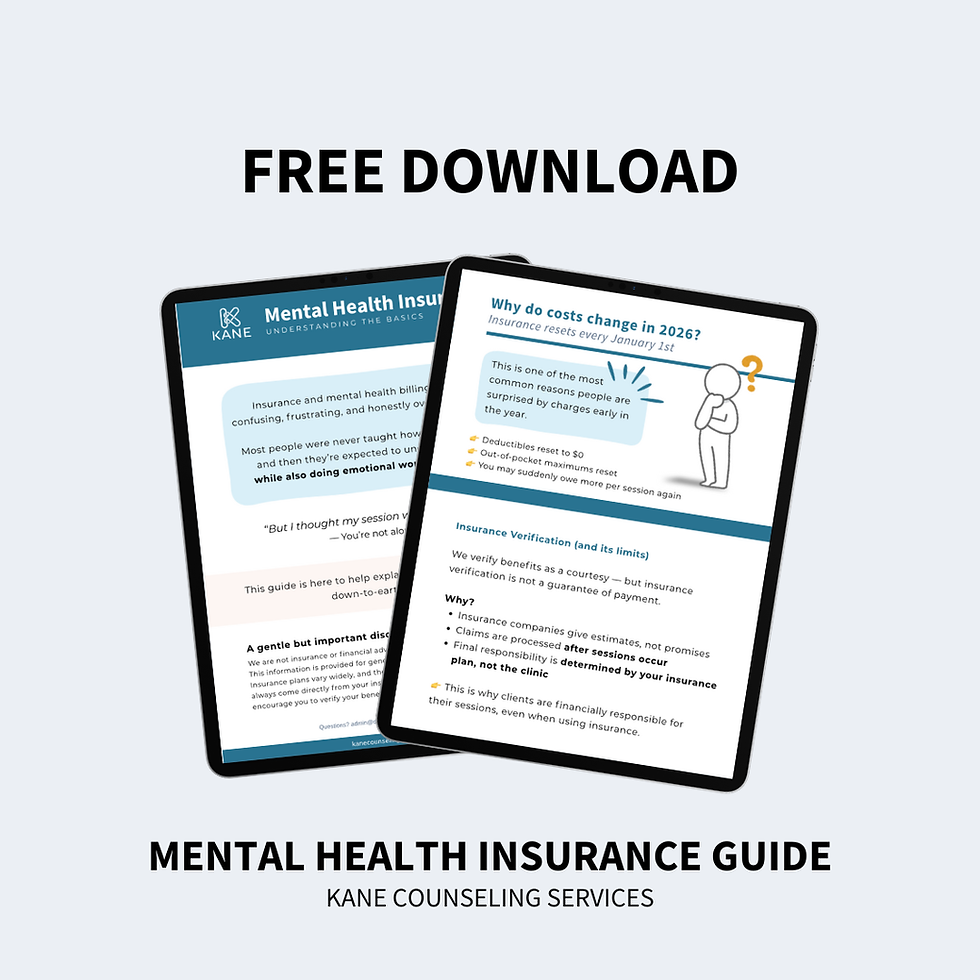
At Kane Counseling Services, we work with many major insurance providers and help clients understand their benefits before beginning care whenever possible.
What Most People Do Not Realize About Insurance Coverage for Therapy
Many people assume:“My insurance covers therapy.”
But the details matter.
Before beginning therapy, it is important to understand:
Your deductible
Copays
Coinsurance
Session limits
Whether preauthorization is required
Whether your therapist is in-network
Whether couples or family therapy is covered
Whether telehealth is included
Whether your plan requires a diagnosis for coverage
Many insurance plans only reimburse therapy that is considered “medically necessary,” which often requires a diagnosable mental health condition.
That can surprise people who are seeking therapy for:
Relationship stress
Parenting challenges
Life transitions
Communication struggles
Emotional growth
Preventative support
This does not mean insurance is bad. It simply means understanding your coverage helps you make more informed decisions.
Therapy Should Not Feel This Hard to Navigate
One of the biggest frustrations people experience is not therapy itself.
It is:
Therapist-shopping overwhelm
Fragmented care
Disconnected providers
Long waitlists
Feeling unsure where to start
Having to retell your story repeatedly
Trying to coordinate support alone
That is one reason we built Kane Counseling Services differently.
More connected
More approachable
Easier to begin
Easier to sustain
Better integrated into real life
Our connected care team helps children, teens, adults, couples, and families receive support in one place, with guidance designed to reduce overwhelm instead of adding to it.
You do not have to have everything figured out before reaching out.
You do not have to know exactly which therapist to choose.
You do not have to navigate this alone.
Not Sure Which Option Is Right for You?
Whether you are considering:
Insurance
Private pay
HSA/FSA
Clergy-supported therapy
Financial assistance opportunities
our front desk team is here to help you explore your options and answer questions without pressure.
Sometimes the hardest part is simply taking the first step.
But support should not feel harder than the life you are already living.
Ready to get started?
Contact Kane Counseling Services at 385-223-0777 or Book Online


Very informative post and easy to read. The discussion here made me think about games with lots of variety. That's one reason people enjoy Geometry Dash levels, since every stage introduces something new.